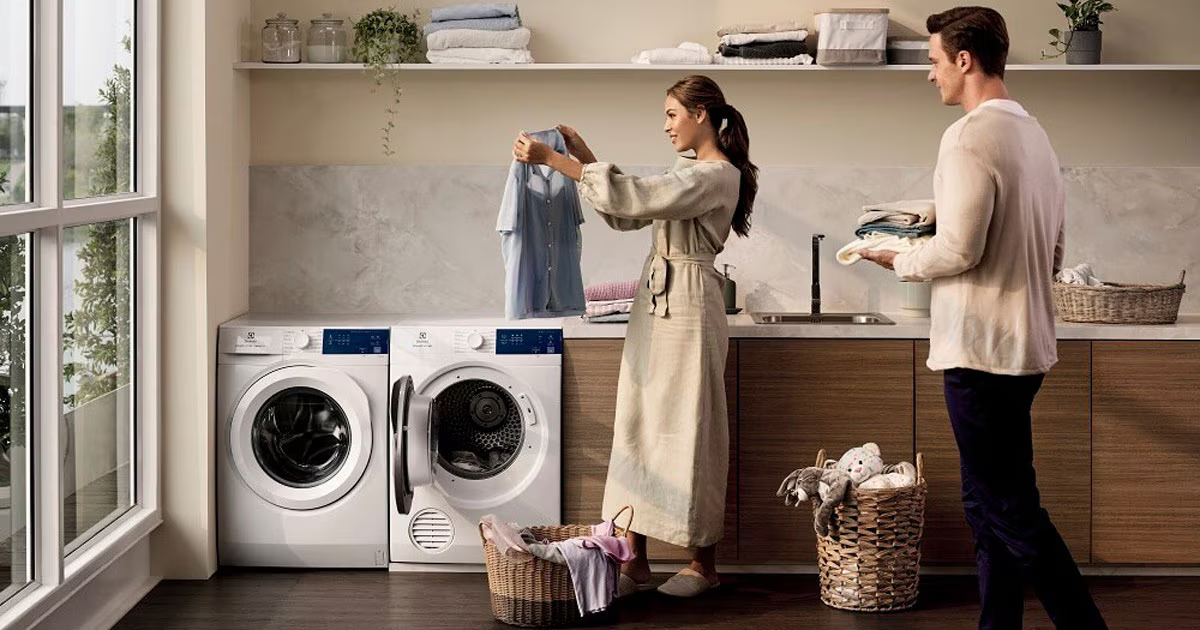
It began with something so ordinary I barely gave it a second thought: my washing machine started leaking. Annoyed but pragmatic, I called a repair service. A young technician showed up, fixed the issue in no time, and packed up his tools. I thanked him, paid, and walked him to the door.
That’s when everything shifted.
Just as he reached the threshold, his cheeks flushed and he extended a tiny folded slip of paper toward me. I hesitated before opening it, thinking it might be a receipt I’d forgotten. Instead, the message read: “Please call me. It’s about someone you know.”
My first reaction? Strange. Strange enough that I nearly tossed it in the trash. But something about the young man—his lowered eyes, the tremor in his fingers—made me stop. His name was Ruben, around twenty-five, quiet and respectful. He hardly seemed like the type to hand cryptic notes to a graying woman in comfortable clothes surrounded by mismatched socks.
A Phone Call That Turned My World Upside Down
The next morning, curiosity defeated hesitation, and I dialed the number. Ruben picked up immediately.
“Hi, I’m… the washing machine lady,” I said, suddenly self-conscious.
He let out a breath. “Thanks for calling. I didn’t know how else to approach this. Um… do you know someone named Felix Deren?”
Hearing that name felt like someone had grabbed the air out of my lungs. I dropped onto the couch.
Felix—my ex-husband.
We hadn’t spoken in seven years, not since our rough divorce. He’d disappeared somewhere out west, and because we had no children or property to tie us together, the silence just calcified. Everyone said I was better off. Still, there was a time when I believed he hung the moon.
“Yes… I knew him,” I said cautiously. “Why?”
A soft pause. Then Ruben said, “He was my father.”
I could only stare at the wall.
“I didn’t want to scare you,” he added quickly. “I only found out a few months ago—after he passed.”
Passed.
The word hit like a stone.
“He died?” I whispered.
“In February.”
It was already June.

What Felix Left Behind
Ruben explained that Felix had lived in San Luis Obispo, spending his final years painting and keeping mostly to himself. Ruben’s mother, Elira, had a brief relationship with him decades earlier but never told Felix he had a son.
“He left a box for me,” Ruben said. “There was a letter, old photos… and your name.”
He asked if we could meet.
The next day, we sat in a cozy café. When he walked in, I felt a pang deep in my chest—he had Felix’s thick eyebrows and the same calm intensity in his eyes.
He handed me a worn envelope bearing my name in a handwriting I once knew better than my own.
Inside was a four-page letter.
The first page—an apology for the way our marriage ended, for his withdrawal, for lacking the courage to fight for us.
The second—memories so specific and tender they brought tears to my eyes: how I hummed while folding towels, how I cried at that pet food commercial and pretended it was allergies.
The third—about Ruben. About discovering, only a year before he died, that he had a son. He had tried to reach him, but Elira never responded. He left Ruben money, books, and messages he hoped his son would someday read.
And the final page—written to me. Asking for forgiveness he didn’t expect. Asking me, if Ruben ever found me, to be kind to him.
“He’s a better man than I ever managed to be,” he wrote.
I looked up, vision blurred. Ruben just sat quietly, giving me space.
Slowly, a New Kind of Family Began to Form
In the following weeks, Ruben and I kept in touch. He stopped by to repair my squeaky dryer, then again when my sprinklers rebelled. I began baking again—something I’d abandoned long ago—and always sent him home with extra.
One evening, while we drank lemonade on my porch, he confessed softly, “I used to wonder what having a family felt like.”
I answered honestly: “I used to wonder too.”
After that, he called every Sunday. Just small conversations—recipes, documentaries, work updates—but they began to stitch a quiet bond between us.
Months later, he brought his mother to meet me. I expected awkwardness, maybe tension. Instead, she walked in with a lemon tart and said, “I hope you can teach me to stop burning the crust.”
Elira was warm, blunt, and burdened with guilt. I didn’t judge her. People make imperfect decisions when they’re scared.
Ruben later carried in two canvases.
One took my breath away.
It was me—older, softer, with a half-smile—as if I had paused mid-thought. A portrait Felix had painted entirely from memory.
“There are more,” Ruben whispered. “Dozens.”
I hung the painting in my living room—not out of vanity, but because it reminded me I was someone worth remembering.
Understanding the Things He Never Said
Ruben invited me to an art showing of Felix’s work. We drove together with the windows down and old music playing.
In the gallery, one painting nearly brought me to my knees:
The Last Thing I Remember.
It depicted our old kitchen—the sunlight, the tea, the half-eaten toast. And my red cardigan tossed over the chair.
The morning of our worst fight.
I hadn’t known Felix remembered that moment too. Or that he had been battling cancer quietly for three years.
Home, It Turns Out, Isn’t a Place
Ruben became a steady presence in my life. He taught me to grill a steak properly, helped repaint my kitchen, and showed up with flowers or pastries for no reason other than kindness.
While sorting through Felix’s remaining belongings one evening, we found one last letter tucked in a poetry book:
“To the person who stayed.”
It was meant for whoever stood by Ruben when he finally let himself be loved. It spoke of how people are gardens, not puzzles, and how the most meaningful things arrive quietly—after the storms.
We both sat in silence, absorbing it.
Ruben finally said, “I know I’m not your son. But I’d like to stay in your life. If that’s okay.”
Tears ran down my cheeks as I replied, “You’re already here.”
Now we don’t name what we are. We just are.
He brings groceries when I’m sick. I iron his shirts when he’s exhausted. We argue over movie endings and finish each other’s tea.
Last Christmas, he brought me a framed painting of my house in winter. A tiny figure stood at the door holding a wrench and a pie.
Underneath, Felix’s final message echoed:
“Home Is Who Stays.”
And I realized something true:
Life often returns what you thought you’d lost—just in a new form, through new hands, at a time when you finally know how to receive it.
So yes, the washing machine leaked.
But the repair that mattered… was the one done quietly inside my heart.